Zak lab paper out!
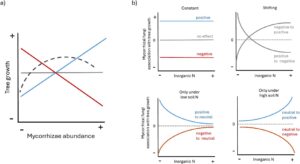
A new paper is out with Ines Ibáñez along with Zak lab collaborators that delves into questions about the true relationship for mycorrhizal fungal relationships with plants and how nitrogen availability affected their behavior. This study looked at growth data in mature trees for two different maple species and one oak species, AMF and EMF-associated, respectively, across a gradient of nitrogen availability. Using this data, we studied the association with specific mycorrhizal taxa to determine whether they had positive, neutral or negative associations with tree growth. As these associations my contribute to how plants respond to future warming conditions, increase N deposition and increased carbon dioxide, it is critical to generate quantifiable data regarding tree performance to help predict future tree growth. The article is titled “Mycorrhizal Fungi Influence on Mature Tree Growth: Stronger in High-Nitrogen Soils for an EMF-Associated Tree and in Low-Nitrogen Soils for Two AMF-Associated -Trees” and can be found here ...

Goodbye Rima!
Rima Upchurch, whom started working in the Zak lab in 2006, has taken a new position at the Cooperative Institute for Great Lakes Research (CIGLR) as a biogeochemist analyst. While she will no longer be working directly on campus, as CIGLR is housed in NOAA’s Great Lakes Environmental Research Laboratory (GLERL), she will continue to be a part of SEAS through CIGLR. Aquatic biogeochemistry is a new world from soils work, but she’s eager to take on the challenge and grateful for everything she has learned in the Zak lab over the years. “Thank you to all the students, post-docs, staff, undergrads and generally just good people I’ve had the chance to work with over the years in Don’s lab. My time learning and growing with all of you was amazing and more than I ever expected when I originally started. And most of all thank you to Don! You’ve been a great boss, an amazing scientist and but most of all just a excellent human being to be around.” ...
Retirement Party!
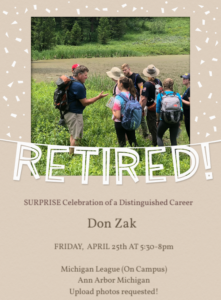
Several past and recent lab alums were able to surprise Don with a retirement Party on April 25th. His official retirement isn’t until the end of May, but being sneaky we had a party early. Don started working as a professor at the University of Michigan for the then School of Natural Resources & Environment in 1988. He has remained a embodied a true professor as not only a celebrated scholar but also a dedicated educator. During his time at Michigan he has won received numerous honors, both for science and teaching, a weathered several Deans and name change to the School for Environment and Sustainability and attended way too many faculty meetings. He taught several courses in both the lab and field, authored/co-authored more than 200 journal articles, contributed and authored chapters in several academic books, was a PI or co-PI on grants totaling more than $21 million dollars, advised more than a dozen post-docs, chaired 16 PhD and 21 MS students to completion. All while raising a family, whom have families of their own now. This seems to boil down his career at the University of Michigan in a few sentences, but the dedication and scholarly achievements that Don has shown cannot be seen in this post. He’s helped so many students attain their goals by being a true mentor to them. His energy and insight will be missed on campus, but he’ll always be an academic and scientific thinker no matter what. Thank you Don from all the people who’s lives you helped guide and for all the wonders of science you lead others to love and understand ...
Jennifer’s paper is live!
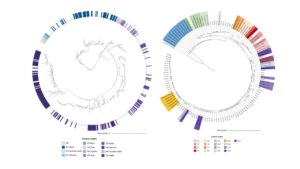
Jennifer Wen, a former SEAS Master’s student in the Zak lab, now has a paper out titled “Ammonium oxidation by bacteria and archaea have functional implications for nitrification across a forested landscape”. This work draws on her thesis work on the amoA gene of archaea along a natural nitrogen mineralization gradient, but it expanded the scope to include ammonia-oxidizing bacteria in the same system. The amoA gene encodes for the gene that is the first step in nitrification, which converts ammonium (NH3+) to nitrite (NO2-), and understanding the diversity and composition of this gene can give us a better understanding for how nitrogen moves through the system. Using self-generated primers, Jennifer found that there were distinct communities across the sites and two environmental variables, soil pH and nitrogen mineralization, were significantly related to the community composition. The paper is out in Ecosphere and can be found here ...
Morgan’s paper is out!
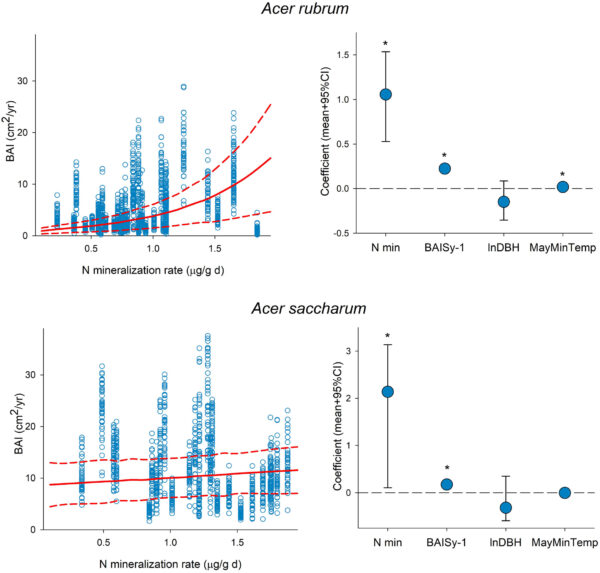
Morgan McPherson, a joint post-doctoral scholar in the Zak and Ibáñez lab at SEAS, has a new paper out titled “Arbuscular mycorrhizal diversity increases across a plant productivity gradient driven by soil nitrogen availability”. This study characterized the arbuscular mycorrhizal fungi (AMF) in soils across a plant productivity gradient, coinciding with a nitrogen mineralization gradient. The soils were associated with Red and Sugar Maple trees in Manistee National Forest, which are known AMF host species. AMF-specific 18S rDNA targeted-gene libraries were constructed using in-lab designed primers to examine the communities and diversity of AMF. Their diversity significantly increased along the productivity gradient, which may be a response to increase carbon allocation from the increased plant growth. These results increase our understanding of the complex symbiosis and turnover of AMF and their interaction with host–plant performance. The paper is out in Plant-Environment Interactions and can be found here ...
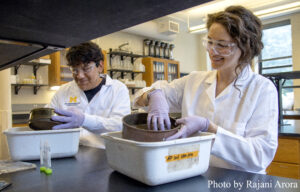
Aspirnaut Olises Perez in the Zak lab
This summer the Zak lab had the opportunity to host Olises Perez as part of the Aspirnaut program. The Aspirnaut Summer Research Internship Program, administered by Life Sciences Institute (LSI), brings rising Michigan high school seniors to UM to give them hands-on lab experience over a 6-week period. The goal is to encourage students, especially those in disadvantaged communities, to strive for education and careers in various STEM fields. Each Aspirnaut works with a mentor to conduct their own research, then presents their results to their peers and other mentors. The project that Olises worked on while in the Zak lab, focused on discovering whether or not Red Oak root tips had more than one type of mycorrhizal associations. Red Oaks are known to host ectomycorrhizal fungi (ECM) on their root tips, and in fact mostly thought to only host ECM. Olises set out to determine if arbuscular mycorrhizae fungi (AMF) were also present in the DNA for these root tips. Morgan McPherson, a postdoctoral scholar in the Zak lab, acted as Olises mentor while at the University. She has an extensive background studying AMF and worked closely with Olises to help him learn the molecular skills needed to examine his question. Amazingly there were 54 out of 106 Red Oak root tips that had AMF! Thank you to Olises for being a great addition to the Zak lab this summer and thank you Morgan for being an awesome mentor ...
Zak lab paper out!
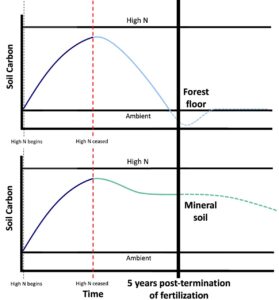
Brooke Propson, a PhD student at the University of Wisconsin, whom works in Zac Freedman’s lab (former Zak lab post-doc), studied the ecosystem response and recovery after the long-term elevated nitrogen treatment was stopped. There is also a natural gradient of ambient N deposition due to human activity at these sites, as well. The study showed that the C in the organic horizon that has previously accumulated from N-treatment has been lost with added deficits post-termination of the treatment with the exception of the northernmost site (least ambient N), showing a shift in mechanistic microbial activity. The mineral soil C still remained observable even after the 5-year termination of the treatment (though not significant). They concluded that most likely the sites are in a disturbed state and will most likely still exhibit higher levels of C storage overtime. The paper is out now and can be found here ...
Zak lab paper out!
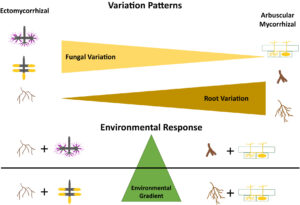
Sam Schaffer-Morrison, former SEAS student and current PhD in EEB at Michigan, has a review out with Don that argues that functional traits of mycorrhizal fungi should be included for consideration when belowground functional traits are being examined. These are incredibly important symbionts could add key mechanistic factors for plant performance (via nutrient uptake) if included in plant-soil discussions. They propose several key fungal traits that are measurable and ways to incorporate them into future research. This paper is out in Ecosphere here ...
